High-Masking Autism in Girls vs. Boys: Why So Many Go Undiagnosed Until Later in Life
High masking autism refers to a pattern where someone consciously or unconsciously hides or compensates for autistic traits well enough to pass as neurotypical at school, at work, and even with family. It shows up across gender, but it's especially common in girls and women, whose social imitation skills and quieter presentation of autism often lead teachers, pediatricians, and parents to miss the signs entirely. That gap is a major driver of late diagnosed autism. At Coast Psychology in Oyster Bay, NY, our psychologists are trained to recognize these presentations through our evaluations for children, teens, and adults across Nassau County, Long Island, and the greater New York City area.
What Is Masking in Autism?
Masking, sometimes called camouflaging, is the effort an autistic person puts into suppressing natural traits and performing neurotypical behavior instead: forcing eye contact, scripting conversations in advance, mimicking peers' tone and body language, or rehearsing social interactions after-the-fact to figure out what went wrong.
Masking isn't dishonesty and it isn't a choice made lightly. For many people, it's a survival skill, built up over years specifically because their early environment made unmasked autistic traits feel unsafe or unwelcome. The cost, though, is real. Research on camouflaging links it to exhaustion, anxiety, depression, and a delayed or missed diagnosis, since the very behaviors clinicians are trained to look for are the ones that evade detection.
Why Autism Presents Differently in Girls vs. Boys
Autism is identified more often in boys. According to the CDC's most recent surveillance data, boys are diagnosed at roughly three-to-four times the rate of girls, though that gap has been narrowing as clinicians get better at recognizing how autism shows up outside the classic, historically male-centered profile. Some of that gap is a real difference in prevalence, but a large part of it comes down to presentation and detection:
| Boys | Girls | |
|---|---|---|
| Special interests | Intense interest and knowledge in unusual topics like trains, statistics, a specific era (e.g., World War II) | More "mainstream" interests in things like animals, a book series, a celebrity (e.g., Taylor Swift) held with unusual intensity. |
| Social behavior | Visible difficulty initiating or decoding peer interaction. | Active imitation of peers' speech and mannerisms — "social echoing." |
| Repetitive behavior | Often overt (e.g., hand flapping, lining objects up) | Often internalized or more minute (e.g., skin picking, hair twirling, mental scripting). |
| Meltdowns | More likely outwardly observable at school or in public. | More likely at home, after holding it together all day. |
| Adult impression | Flagged early by teachers as "different." | Called shy, sensitive, aloof, or a perfectionist. |
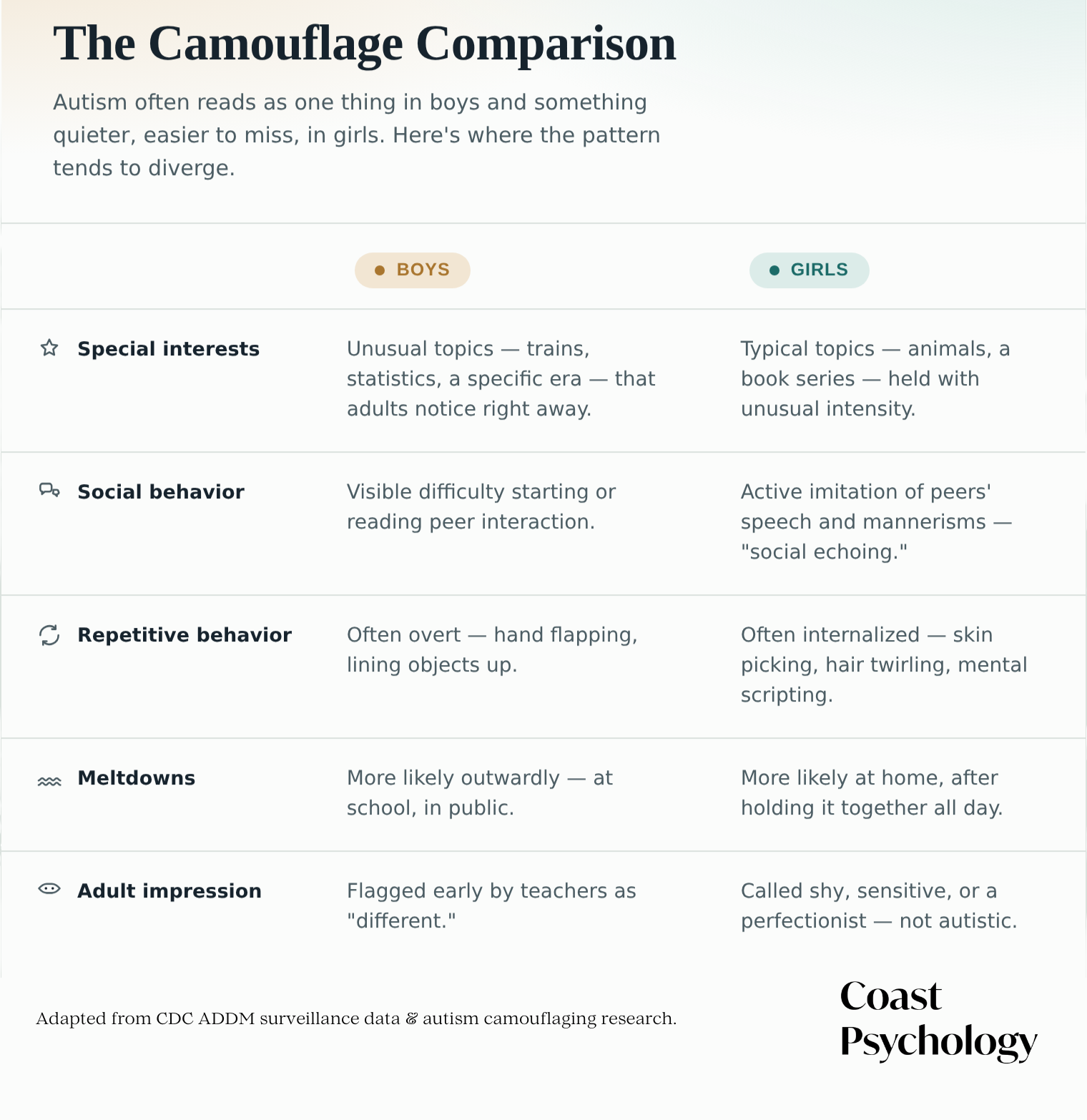
None of this means autism is fundamentally different by sex. It means the outward behaviors clinicians and teachers were trained to watch for were drawn largely from research on boys, and girls' compensating strategies are good enough, often for years, to keep the underlying pattern out of view.
Signs of High Masking Autism by Age
Early Childhood (Ages 3–7)
Intense focus on age-typical interests (animals, princesses, a specific show) that's still notably narrower or more consuming than peers'
Copying other children's play and speech patterns rather than initiating original play
Appearing social on the surface, while parents notice she doesn't really connect with peers one-on-one
Meltdowns or shutdowns that happen almost exclusively at home, right after school or daycare
Being described as "quirky," "sensitive," or "in her own world"
Elementary & Middle School (Ages 8–13)
Excelling academically or socially on paper while parents sense something is being held together with effort
Exhaustion, irritability, or meltdowns after school that don't match how the day was described by teachers
A small number of close friendships, or friendships that follow a script the child has consciously worked out
Heightened anxiety, perfectionism, or people pleasing that gets attributed entirely to personality
Sensory sensitivities (tags, textures, noise)
Teens & Adults
A diagnosis history of anxiety, depression, OCD, ODD, or an eating disorder that doesn’t fully explain the whole picture
Years spent consciously studying and rehearsing social rules that seem to come naturally to others
Deep fatigue or burnout after socializing, even when the socializing "went fine"
A strong sense of having performed a version of themselves for most of their life, often described as feeling like a fraud
A late diagnosed autism identification, frequently prompted by a partner's, child's, or sibling's diagnosis that suddenly makes their own life make sense
Why So Many Girls and Women Receive a Late Autism Diagnosis
Late diagnosed autism isn't a sign the condition arrived later in life. It's almost always a sign the pattern was there all along and simply wasn't recognized, for reasons that compound over time:
Diagnostic tools were built on male samples. Many widely used screening and diagnostic instruments were developed and validated primarily on autistic boys, so they're better tuned to catch a male presentation.
Compensation looks like competence. A masking child who is also intelligent, verbal, and motivated to fit in can look like she's simply thriving, even while the effort it takes is unsustainable.
Co-occurring conditions absorb the explanation. Anxiety, depression, ADHD, and eating disorders are diagnosed at high rates in autistic girls and women, and once one of those labels is applied, clinicians and families often stop looking further. This is also called diagnostic overshadowing.
Social expectations reward masking. Girls are frequently socialized from an early age to prioritize other people's comfort, which reinforces exactly the compensating behaviors that keep autism hidden.
The result is a well documented pattern: many girls and women aren't identified until adolescence, young adulthood, or well into their thirties or forties, often after a family member's diagnosis prompts them to look at their own history differently.
Why a Comprehensive Evaluation Matters
A quiz found online, a single classroom observation, or a short screening isn't built to catch a masked presentation. Masking is, by definition, a set of learned behaviors designed to pass as neurotypical. Properly identifying it requires a clinician who knows what to ask about beneath the surface including a deep review of internal experience, sensory history, developmental history, and the gap between how someone appears and how much effort that appearance costs them.
A comprehensive evaluation looks at the whole person rather than a checklist built around the classic presentation: cognitive functioning, social communication across settings, sensory processing, executive functioning, and co-occurring conditions like anxiety or ADHD that often travel alongside autism. That fuller picture is what allows for an accurate diagnosis instead of another decade of partial explanations.
What an Autism Evaluation at Coast Psychology Includes
A clinical interview and detailed developmental, social, and educational history, including input from parents, partners, or other close observers where relevant.
Standardized autism specific measures alongside broader cognitive and social communication testing, not a single instrument in isolation. This may include use of the ADI-R, ADOS-2, or MIGDAS, two well-known tools used by psychologists in evaluating for autism.
Direct attention to camouflaging and compensating behaviors, not just the classic, more outwardly visible traits.
Screening for commonly co-occurring conditions, including anxiety, depression, and ADHD.
A clear, written report that translates results into plain language, with recommendations tailored to school, home, or adult life.
Where to Go for an Autism Evaluation Near You
Coast Psychology is based in a National Historic Landmark Victorian building in the heart of downtown Oyster Bay, NY (11771). We evaluate children as young as 4, adolescents, and adults, including women, pursuing a first diagnosis later in life, across Nassau County and Long Island, as well as Westchester, Queens, Manhattan, Brooklyn, and the rest of the New York City area, with a hybrid schedule designed to make the process manageable for busy families and adults balancing work and life. If a broader learning difference runs alongside the picture you're seeing, our companion article on the subtypes of learning disabilities walks through how those conditions frequently overlap with autism.
Frequently Asked Questions
What is high masking autism?
High masking autism describes an autistic presentation where the person has learned, often unconsciously, to hide or compensate for traits that would otherwise be visible to others. It's common in girls and women, and it's a major reason autism can go unrecognized for years.
Why are girls diagnosed with autism later than boys?
A combination of factors: diagnostic tools built largely around a male presentation, stronger social imitation skills that make girls' traits less visible, co-occurring conditions like anxiety or depression that absorb the explanation, and social expectations that reward exactly the compensating behaviors that keep autism hidden.
Can adults be diagnosed with autism for the first time?
Yes. Late diagnosed autism is common, and many adults, women in particular, are identified for the first time in their adolescent years, twenties, thirties, or later, often after a family member's diagnosis prompts a closer look at their own history.
Is masking the same as being shy or introverted?
No, though it can look similar from the outside. Shyness doesn't require the sustained, effortful performance that masking does, and masking is specifically about suppressing or hiding autistic traits rather than a general personality style.
Does a late autism diagnosis still help, even in adulthood?
Yes. Many adults describe a late diagnosis as clarifying rather than difficult, since it reframes a lifetime of self-blame into an accurate explanation and opens the door to supports, accommodations, and self-understanding that weren't available before.
Is an autism evaluation covered by insurance?
Coverage varies by plan. Many families and individuals use out-of-network benefits or pay privately. Reach out to hello@coast-psychology.com to discuss your specific situation.
Ready to Get Answers?
If you're ready to move from wondering to knowing, Coast Psychology is here to help. Our team provides comprehensive, evidence based evaluations for children as young as 4, adolescents, and adults, across Oyster Bay, Nassau County, Long Island, and the greater New York City area.
Reach out to hello@coast-psychology.com to ask questions or schedule an evaluation. We're happy to talk through what the process looks like before you commit to anything.